Books are like people, in the sense that they’ll turn up in your life when you most need them.
— Emma Thompson
There’s a book on my shelf that I’ve been meaning to read for some time now. There’s no particular reason I haven’t. It’s not a large book. It’s not a complex book. In fact, it’s a classic, something I probably should have read by now, but in any case, certainly worth cracking open.
More importantly, there’s an expectation it would be read.
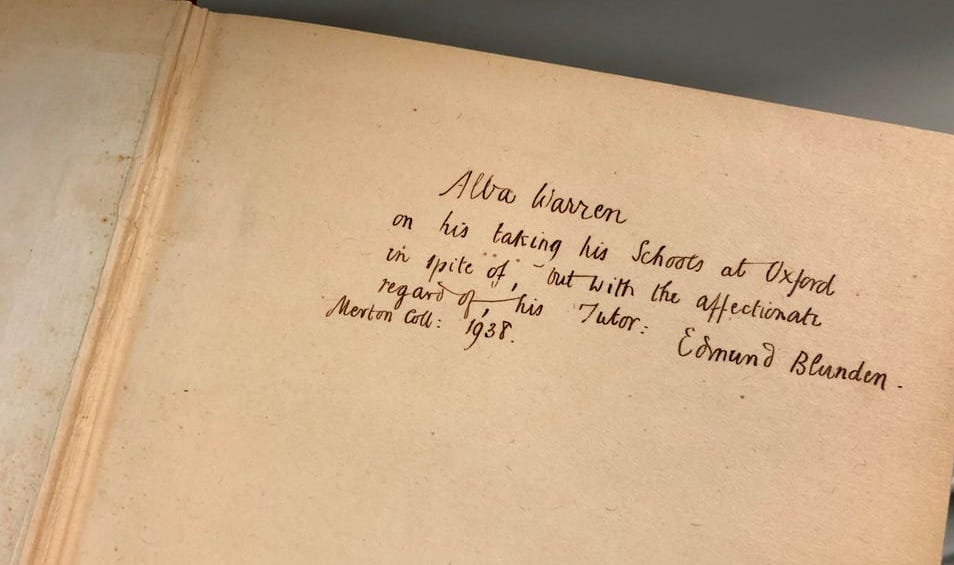
That’s me projecting. But when an inscribed book is gifted by a relative higher up in the org chart—in this case, an Aunt, Aunt Claire—there are expectations.
We recommend restaurants. Suggest plumbers, mechanics, and doctors. Insist on movies and TV shows you “just have to watch.” These are the casual advocacies we dispense freely, quickly forgotten if no one follows through.
But a book? That’s altogether different.
Nobody gifts a book they finished with a resounding sigh. The books we give are the ones that changed lives—most importantly, our own. We pass them on wrapped in altruism, with a faint but unmistakable hint of narcissism inside.
Our relationship with books is personal. And when they pass from our hands to others we have expectations, a desire for them to travel a certain path with a specific outcome. It’s a human trait, no more unique to a random relative than to a billionaire.
Like J.P. Morgan.
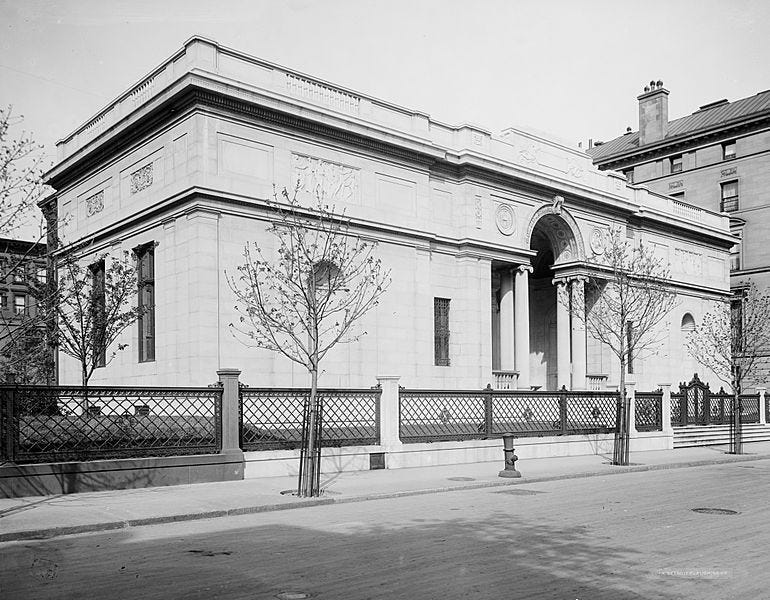
Morgan was already one of the most powerful men in America when he started seriously collecting in the 1890s. He built a private library adjacent to his Manhattan townhouse and filled it with the rarest books money could buy. And for decades, it stayed exactly as he wanted: closed.
Well, mostly closed. To avoid import taxes on the treasures he was hauling back from Europe, Morgan was required to open the library to the public. He complied, barely—by appointment only, to ‘scholars’ who could prove they had legitimate reasons for being there.
But then life intervened in the form of death, which can be inconvenient for men accustomed to being in charge, so Morgan tried to maintain control of his books from beyond the grave.
His will is often quoted as evidence of noble intent. He wrote that it had been his “desire and intention” to make the collection “permanently available for the instruction and pleasure of the American people”—a sentence that sounds generous until you read the rest.
He didn’t say open to the public. He didn’t say free access. Instead: “some suitable disposition... of such portion... as I might determine,” then left “the whole subject, without recommendation or restriction” to his son.
In other words: Do whatever you think is appropriate, Jack.
Jack Morgan took the wink, the nod, and the hint. In 1924, he incorporated the library as a “public institution,” then restricted access to ten researchers at a time, by appointment only.
For eighteen years, that counted as public.
In justifying this arrangement, the younger Morgan was quoted as saying, “After all, one soiled thumb could undo the work of 900 years.”
Fair point. Imagine what a toe could do.
Fast forward to 1942, when NYC Mayor Fiorello La Guardia, an urban populist who had a particular interest in ensuring tax-exempt cultural institutions actually served the public, finally decided to call their bluff.
So he sued.
The New York Supreme Court sided with the library, ruling that they were in fact public and could keep their tax exemption. But the publicity from the trial changed everything.
The U.S. was in the middle of World War II and public sentiment had soured on the excess and privilege of Gilded Age holdouts. To avoid future challenges, the library began opening its doors wider—public exhibitions, broader access, a genuine effort to look like what they’d been calling themselves for nearly two decades.
One month after the court’s ruling, Jack Morgan, the last of the legacy protectors, died, and the private era was over.
If you enjoy this, subscribe here.
If J.P. Morgan couldn’t control the destiny of his books, what chance did Aunt Claire have?
We don’t explicitly know what her wishes were, but from the inscription, the implication is clear:
Dearest Rebecca,
I first read this when I was your age, and I’m not sure I’ve truly left the moors since. They call it a romance, but it is really a thunderstorm in a book. I see that same restless spark in your eyes that I had then, and I suspect you’ll find the “darkness” of Heathcliff just as thrilling as I did.
Read it when the wind is up. I expect we shall have much to discuss.
With all my love, Aunt Claire 1994
Who knows what happened after that. Maybe she gave it to Rebecca. Maybe Rebecca loved it and discussed it with Claire over tea. Maybe Rebecca never opened it. Or perhaps Claire forgot to give it to her and it sat in a drawer until she died.
We don’t know because Claire was nobody important. Not a titan of industry. Not a cultural benefactor. Just another person moving through life with the quiet anonymity that awaits most of us—no foundation, no heirs fighting over intentions, no New York Times coverage, no scholars, no court cases, no mayor stepping in to correct the record.
Morgan’s failure is documented. Aunt Claire’s is uncertain.
All I know for sure is that her gift of Wuthering Heights now sits on my shelf.
Books skip across people like stones across water. Where they touch down—Rebecca or a stranger, scholars or subway commuters, the intended recipient or someone decades later who paid four dollars for it at a rummage sale—the book doesn’t particularly care.
But I do. So after I read it, I’ll append Aunt Claire’s inscription with one of my own. I don’t think she’d mind.
To a future reader,
Aunt Claire wrote to Rebecca. I knew neither, but I’m writing to you.
No matter if you’re a distant offshoot from the family tree, or a random stranger who found this in a thrift store, as I did, you’re as unfamiliar to me as I am to you. But this book found you. And that means something.
What happens with it from here is up to you.
But not really.
If this was worth your time, the next one will be.
Dig Deeper:
How to Write the Perfect Book Inscription — Penguin UK
The Morgan Library & Museum — TheMorgan.org
Signed vs. Inscribed — Ken Lopez Bookseller
The Bibliophile: Everything you love about books — except the reviews.