When I have a little money, I buy books; and if I have any left, I buy food and clothes.
-Desiderius Erasmus
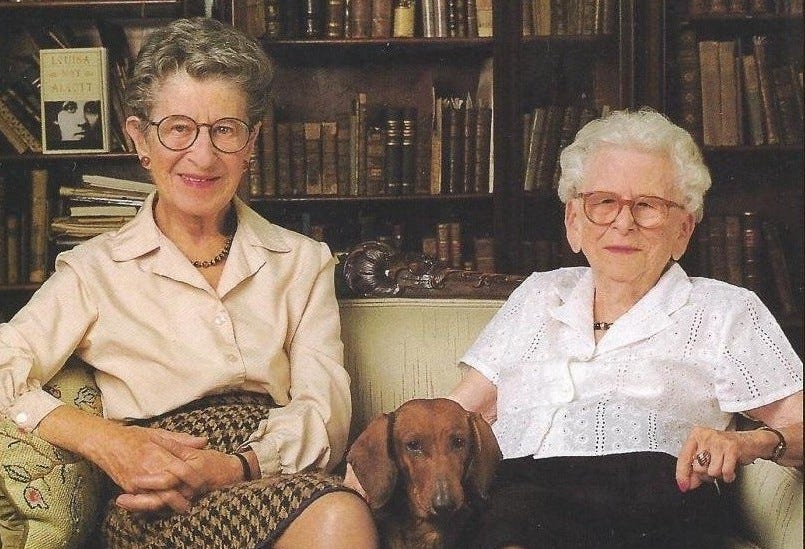
Leona Rostenberg and Madeleine Stern spent sixty years together in an Upper East Side apartment surrounded by books, which is precisely the sort of detail that makes people go misty-eyed and stupid.
Read any of their mainstream profiles and you’ll find the same highlights in the same order. They ran one of America’s premier antiquarian book businesses. They discovered that Louisa May Alcott wrote sensation fiction under a pseudonym. They broke barriers in a field dominated by men. They had dachshunds—dachshunds, for God’s sake.
There will also be the standard we’re-not-interested-but-will-mention-it-anyway allusions to the possibly sapphic nature of their relationship. So that we can dispense with it here and get to what matters: they said they weren’t, common sense says they were, and the curiosity tells us far more about the curious than the women themselves.
Anatomy of Intuition
What’s missing from most accounts of Rostenberg and Stern’s legacy requires a German word, which tells you something. The Germans excel at two things: making the twentieth century considerably worse than it needed to be, and inventing compound nouns that express what the rest of us are too inarticulate to say.
Schadenfreude. Gemütlichkeit. Fingerspitzengefühl. It’s that last one we need.
Intimidating on the page, a glottal train wreck in the throat, it is a characteristically Teutonic construction that sounds like someone dropping a drawer of cutlery but describes something as sublime as a heartbeat.
Fingerspitzengefühl: fingertip feeling. The intuition that lives in the hands, not the head.
Rostenberg and Stern could authenticate a sixteenth-century binding by touch. Date paper by weight. Identify a modern forgery by the way ink sat on the page—not read, sat. Their fingers were instruments calibrated over decades of handling tens of thousands of volumes until variations became as legible as text. Their fingers read.
They described it as “a tingling of the fingertips” that became “an electrical current of suspense, excitement, recognition.” A sensation that occurred while scanning dealer shelves in London, Paris, and across the Continent. An early warning system calibrated by decades of handling books until the hand knew what the eye hadn’t yet confirmed.
The current sparked hundreds of times. Over a slim quarto pamphlet produced in London in 1652, the text and printing supervised by Milton. With a plump notebook bound in vellum, filled with pen and ink sketches. Over a French pamphlet, unbound and ephemeral, reporting the discovery of “Austral Land.”
For over a half century they continued on, handling books no one else could authenticate. They built reputations. They made discoveries. They lived long, grand lives. They died. Leona in 2005. Madeleine in 2007.
From Atoms to Pixels
Outside the immediate, grieving ambit of those who knew and cherished them, nothing catastrophic happened. No libraries burned. The books they authenticated still exist. The texts are online. Access is universal, instantaneous, and democratic.
Madeleine and Leona’s “Milton” now lives on the screen; peered at in Starbucks that smell of burnt-milk-and-detergent steam, studied in the thin blue light of offices that smell of nothing. The efficient, clinical hallmark of progress.
And though technology allows you to zoom in on the scans until the paper fibers look like felled redwoods, the screen will never whisper the tactile secret; the paper is suspiciously, frantically thin—the work of a printer running out of stock while the King was running out of time.
Moving a 1652 quarto from a London basement to a cloud with no nerve endings keeps the lyrics but murders the music.
If you enjoy this, subscribe here.
Leona and Madeleine knew exactly what was being lost: “What electronic process can reproduce the touch and feel of an incunable Book of Hours, an Aldine quarto, the immediacy of an Elzevier duodecimo designed to fit into the pocket so that he who runs may read... Nothing in cyberspace can convey the character and substance of the original.”
Seduced by Progress
In defending the physical, we’re armed with only the esoteric; whispery, nebulous reasoning that sounds less like logic and more like a séance. It is the shamanic insistence that a specific arrangement of atoms holds a resonance that a digital image cannot mirror. But it doesn’t square the ledger. It doesn’t fit the math of a modern world where accessibility equals progress. By every logical metric, the scan is the victory.
Yet, with the screen triumphant, we still insist on the clutter. The stacks you trip over in the hallway. The volumes unopened for decades. The objectively insane practice of owning multiple versions of our favorite books: first editions, new editions, reading copies, mark-up copies, travel copies, signed copies of course, and, yes, all backed up with the most egregious form of sleeping with the enemy, a digital copy.
And that digital copy? Just a small part of the catalogue in our pocket. 50,000 volumes, portable, indestructible, on demand, served up on devices that the curators of the Great Library of Alexandria would describe as “mechanical oracles” — but we know are just the logical apex of the infotainment age.
We’re told we have a library in our pockets, but we don’t. We have a wealth of data. We have information and glowing, backlit fonts, but we don’t have form. Access without intent. We can hold the data of 50,000 books and still have nothing in our hands but a slab of glass. A Kindle is a filing cabinet, but a book is a guest in the room.
We don’t surround ourselves with books because we are scholars, but because we are human. We don’t touch books to extract their information, assess their market value, or validate their provenance. In the words of Leona and Madeleine, “We touch them because we fucking like to touch them.”
Well, maybe those are my words, but I think they would agree.
If this was worth your time, the next one will be.
Dig Deeper:
The “Milton” — The British Library
Leona & Madeline interviewed on Bookends — C-SPAN
Old Books, Rare Friends — Penguin Random House
The Bibliophile: Everything you love about books — except the reviews.