Books are a uniquely portable magic.
-Stephen King
Before you stands an overwhelming array of options. Choose right and your craving is satisfied; choose wrong and you walk away unsated, slightly ashamed, and poorer by a couple bucks.
A chocolate bar? No. That bag of nacho cheese Doritos? Maybe. Definitely not the trail mix—nobody is supposed to buy something healthy, even semi-healthy, from a vending machine. And then you spot it: the perfect antidote to your craving. A brand-new edition of Cormac McCarthy’s The Road.
All new ideas start with a tiny rebellion
The story begins, as many good stories do, with a man dodging the law.
In 1822, English bookseller Richard Carlile invented what may have been the first book vending machine. His goal wasn’t convenience; it was self-preservation. Carlile was peddling seditious works like Thomas Paine’s The Age of Reason and kept finding himself in court for “blasphemous libel.” So he built a self-service contraption that let customers buy banned books without ever coming into contact with him.
It’s unclear whether the device was truly automatic—but it didn’t prevent the authorities from prosecuting one of his assistants for selling books the Empire deemed unfit for polite society.
Still, Carlile’s machine was less an invention than a provocation. A middle finger made of metal. A mechanical loophole that protested with gears, allowing dangerous ideas to circulate freely.
The first book vending machine wasn’t about commerce. It was about subversion. Punk rock before The Pistols.
Penguins, paperbacks, and platform stalls
More than a century later, another publishing heretic gave the idea a second life.
In 1937, Allen Lane, founder of Penguin Books, installed a device called the Penguincubator near London’s Charing Cross Station. It dispensed high-quality paperbacks—Hemingway, Woolf, Christie—for the price of a pack of cigarettes.
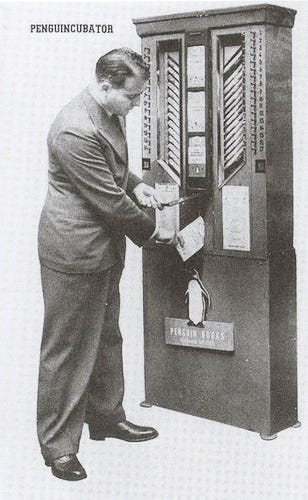
Lane’s mission wasn’t to sneak around the censors but to undermine the snobbery of the book trade. He wanted good literature to live not just in bookstores but in railway stations, tobacconists, and corner shops. To Lane, a paperback wasn’t a cheaper book; it was an act of democracy.
The Penguincubator didn’t catch on. Perhaps it was too odd, too literal a metaphor. Still, its spirit endured. Every airport bookstore, every two-for-one classics display, owes something to Lane’s stubborn belief that culture should be as accessible as candy.
The midcentury machine dream
After the war, America took its turn. The country that had already mechanized nearly everything decided to mechanize literature too.
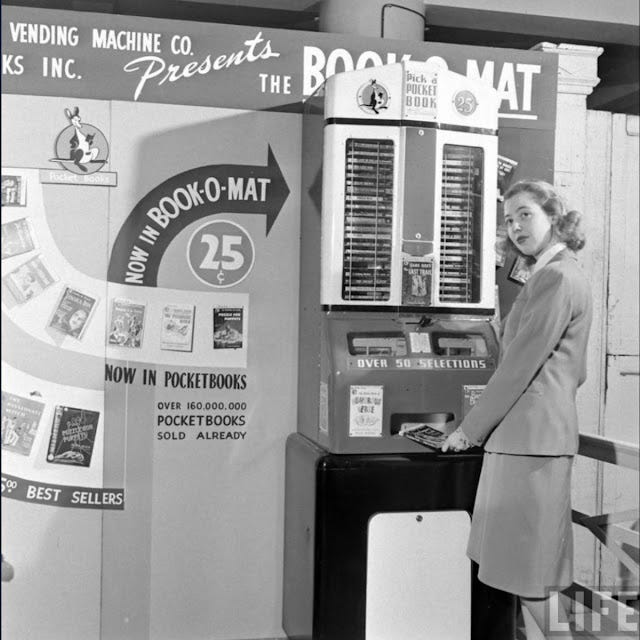
In 1947, Popular Science featured the Book-O-Mat, a metal box offering fifty titles for twenty-five cents apiece. Two years later, the jukebox company Rock-Ola introduced an upgraded model, promising operators a slice of the “multi-million dollar paperback book business.”
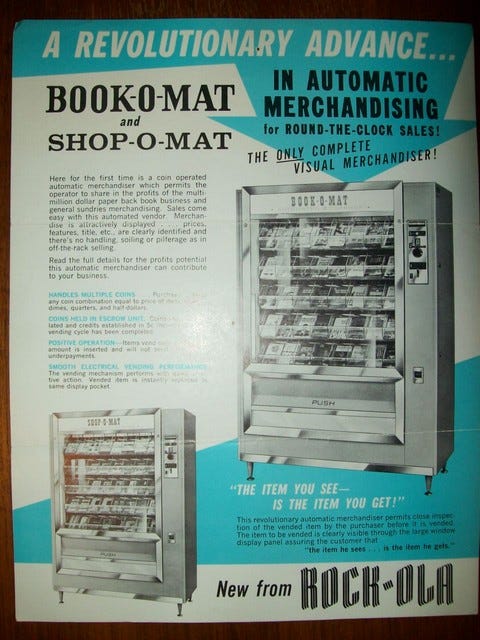
It was a perfect midcentury fantasy: literature with a coin slot. No clerks, no conversation, just a crisp rectangle of enlightenment dropping with a clunk.
But books, it turns out, make terrible vending products. They’re bulky, irregularly shaped, and require an emotional investment, the opposite of an impulse item, particularly when you’re rushing to catch your train.
If you enjoy this, subscribe here.
The Biblio-Mat: Serendipity over selection
If the Book-O-Mat was commerce’s attempt to sell literature, the Biblio-Mat is literature’s revenge.
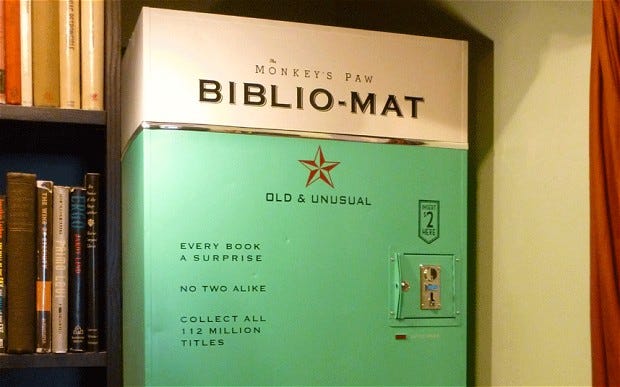
Installed in 2012 inside The Monkey’s Paw bookstore in Toronto, the Biblio-Mat dispenses random used books. You insert a coin—well, a Canadian coin—a bell rings, and an unseen mechanism spits out your fate: an old dictionary, a forgotten travelogue, maybe a biography of a minor Hungarian composer.
“You don’t choose the book,” said Stephen Fowler, the shop’s owner and creator of the machine. “The universe chooses it for you.”
It’s both absurd and beautiful—a vending machine that understands how unsuited vending is to books. The inverse of the sterile algorithms that have made discovery feel mechanical, it offers surprise, whimsy, and the thrill of relinquishing control.
Putting the machines in their place
Every generation rediscovers the idea of vending books. Carlile wanted freedom, Lane wanted democracy, Rock-Ola wanted profit, and the Biblio-Mat just wanted to amuse us.
But books will never vend well—at least not commercially.
That’s comforting. Knowing that in a world of digital downloads and drone deliveries, a book remains a stubbornly human object, to be browsed, handled, judged by covers and weight and scent. They’re not consumed; they’re experienced.
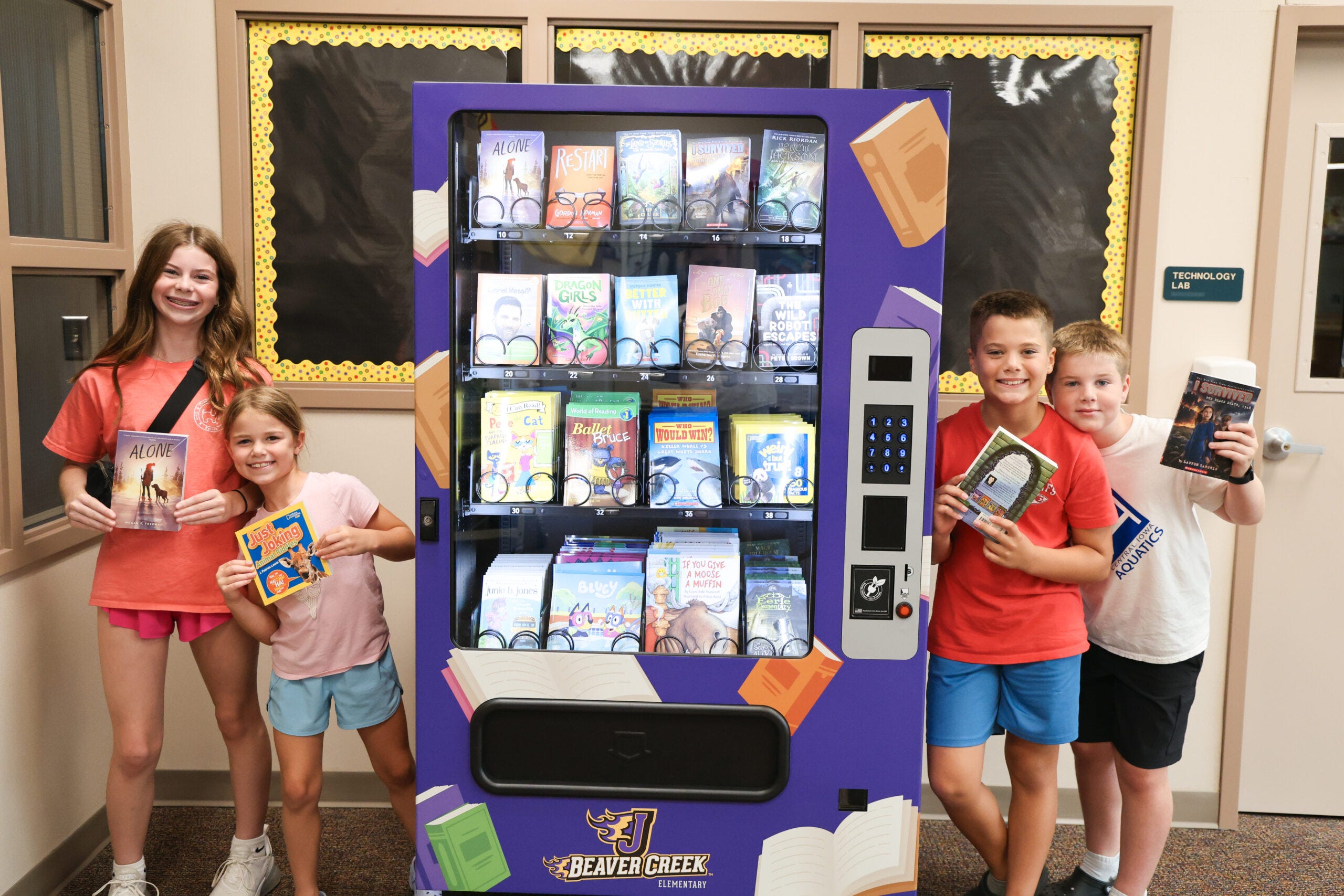
Book vending machines still exist, but flourish most where profit isn’t the point, where they can put a book in hands that might not otherwise reach the shelf, and where a library card, not cash, is the price of admission.
If this was worth your time, the next one will be.
Dig Deeper:
Richard Carlile: free press, women’s rights, and intellectual rebellion — Spartacus Educational
The 1937 Penguincubator — Mental Floss
The mechanics behind the Biblio-Mat — Vimeo
The Bibliophile: Everything you love about books — except the reviews.